Glasgow Anxiety Therapy
Key Takeaways
Anxiety therapy in Glasgow is widely available through private clinics, NHS services, university counselling, and online platforms, meaning you can access support regardless of your situation or budget.
Evidence-based approaches such as cognitive behavioural therapy, person centred counselling, EMDR, and mindfulness are commonly used by Glasgow-based therapists for anxiety, panic attacks, obsessive compulsive disorder, and health anxiety.
Private anxiety therapy in Glasgow can usually be started within days or weeks, while NHS waiting lists may run to several months in 2025.
Both in-person sessions across areas like Glasgow City Centre, Southside, and West End and secure online therapy options are available for adults, students, and teenagers.
Anxiety is treatable. You are not broken. Therapy focuses on practical tools to help you feel calmer, more in control, and better equipped to handle stressful situations.
Does This Feel Like Your Anxiety in Glasgow?
Anxiety has a way of weaving itself into daily life without asking permission. Maybe it’s the tightness in your chest on the morning commute, the racing thoughts before a work presentation, or the 3am spiral about something you said last week. For many clients across Glasgow, anxiety doesn’t announce itself—it just gradually takes up more and more space.
Physical symptoms many clients report: A racing heart, tight chest, nausea, dizziness, difficulty concentrating, and sleep problems are among the most common psychological symptoms that bring people to anxiety counselling in Glasgow. Some describe feeling tense constantly, while others experience sudden waves of panic that seem to come from nowhere.
Mental symptoms that won’t switch off: Constant worry about money, relationships, health, or the future. The relentless “what if?” thoughts that make you feel unable to relax. Many clients describe anxious thoughts that loop endlessly, leaving them exhausted but unable to rest.
Behavioural patterns that shrink your world: Avoiding social situations in the city centre, calling in sick because you feel anxious about work, cancelling plans at the last minute, or spending hours seeking reassurance online about symptoms you’ve already researched a hundred times.
University pressures: Students at University of Glasgow, Glasgow Caledonian University, and University of Strathclyde often experience intense exam stress, performance pressure, and social anxiety disorder that can significantly impact academic performance and wellbeing.
You’re not alone in this: These experiences are far more common than most people realise. Anxiety affects roughly 20% of UK adults annually, and Glasgow’s mental health services see consistent demand for support. The following sections explain how Glasgow anxiety therapy can help you manage anxiety and start feeling like yourself again.
Anxiety Therapy in Glasgow: How It Works
Therapy in Glasgow typically starts with an assessment session followed by regular weekly or fortnightly appointments. The pace and structure are designed to build trust, establish safety, and create space for genuine change—not to rush you through a checklist.
Initial consultation: Many Glasgow therapists offer a free or low-cost 15–20 minute initial consultation by phone or video. This is your chance to discuss your needs, ask questions, and get a sense of whether the therapist feels like a good fit.
First full session: Your first session (usually 50–60 minutes) is an assessment. You’ll explore your symptoms, personal history, triggers, and what you hope to achieve through therapy. There’s no pressure to have everything figured out—this is collaborative work.
Flexible session formats: Sessions can be in-person at consulting rooms across Glasgow (city centre, West End, Southside), online via secure video platforms, or by phone. Many clients appreciate having options that fit around work, childcare, or mobility needs.
Consistent rhythm: Most private therapists offer one to one sessions at the same time each week. This consistency helps build momentum and creates a sense of safety that supports deeper work.
Variable length of therapy: Some people benefit from 6–12 CBT sessions focused on specific goals. Others choose longer-term work over several months to address deeper patterns. There’s no one-size-fits-all approach.
Tailored plans: Your therapy plan will combine skills-based tools with space to talk through difficult emotions and make sense of life events. The approach is always adapted to you as an individual client.
Private vs NHS Anxiety Therapy in Glasgow
Both NHS and private routes are available in Glasgow, each with distinct advantages and limitations worth considering.
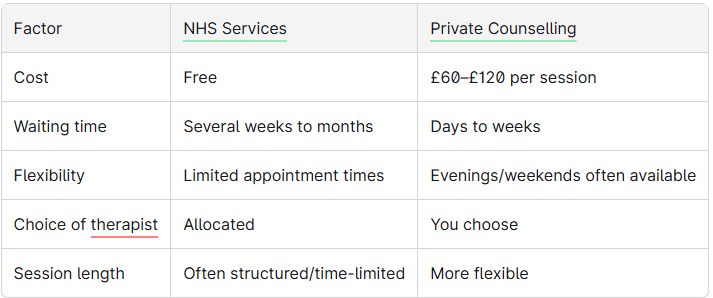
NHS provision: NHS Greater Glasgow & Clyde offers free anxiety support through GPs, mental health teams, and services like structured CBT courses. These services are delivered by qualified professionals and backed by the national institute for health and care excellence guidelines.
Current waiting times: In 2025, NHS waiting times for psychological therapies in Glasgow can range from several weeks to many months, depending on demand and complexity of need. This is a reality many clients find frustrating when they’re struggling now.
Private advantages: Private therapy typically offers faster access, more flexibility in appointment times, and the ability to choose your anxiety therapist based on their approach, experience, and personality.
Investment considerations: Private therapy is usually paid per session. Some therapists offer reduced rates for students, young people, or those on lower incomes. It’s worth asking directly.
Making the choice: Speak to your GP about NHS options, and contact individual private therapists to discuss fees, availability, and suitability before deciding. Many people find the right path forward by exploring both options.
What to Expect in a Typical Anxiety Session
Sessions move at your pace. You don’t need to know exactly what to say or have a prepared script. Your therapist is there to provide support and guide the conversation, not to judge or rush you.
Check-in: Sessions usually begin with a brief check-in about the past week—any anxiety spikes, any wins, anything that’s been on your mind.
Goal-focused work: The therapist and client then focus on agreed goals, such as reducing panic attacks, facing feared social situations, improving sleep, or addressing low mood.
CBT-style elements: In CBT-based sessions, you might review thought records, plan gradual exposure therapy tasks, or practise breathing and grounding exercises. These are practical tools you can use between sessions.
Deeper exploration: More integrative or person centred counselling sessions may include exploring childhood experiences, relationship issues, and core beliefs that fuel anxiety and low self esteem.
Closing the session: Therapy usually finishes with a short summary, agreed homework or focus for the week, and time for any questions. This structure helps you carry insights into your daily life.
Types of Anxiety Commonly Treated in Glasgow
Glasgow therapists support a wide range of anxiety-related difficulties. Many clients experience overlapping symptoms, which is completely normal. Here are the most common presentations:
Generalised anxiety: Constant worry about everyday issues—work, finances, health, family—often without a clear trigger. This can manifest as feeling tense, restless, or on edge most of the time.
Social anxiety: Fear of being judged in pubs, workplaces, lectures, or social events. This often leads to avoidance, loneliness, and identity issues around self-worth.
Panic disorder: Recurring panic attacks on public transport, in shopping centres, at gigs, or at work. The fear of future attacks can become as debilitating as the attacks themselves.
Health anxiety: Frequent checking of symptoms, repeated GP visits, and persistent worry about serious illness despite medical reassurance. Many clients describe this as exhausting and all-consuming.
OCD and intrusive thoughts: Obsessive compulsive disorder involves obsessions about harm, contamination, or mistakes, and compulsions such as checking, cleaning, or mental rituals. These patterns can take hours from each day.
Specific phobias and performance anxiety: Fears around elevators, flying from Glasgow Airport, driving on motorways, public speaking, or presentations. Exam-related anxiety is particularly common among pupils and university students.
How Therapy Addresses These Anxiety Types
While anxiety types differ in their specifics, therapy focuses on changing unhelpful patterns in thoughts, feelings, and behaviour. The goal is practical: helping you feel calmer and more in control.
Recognising triggers: Therapists teach clients to notice triggers and early warning signs to prevent anxiety from escalating. Awareness is often the first step toward change.
Challenging negative thoughts: Therapy helps challenge catastrophic thinking and replace it with more balanced, realistic perspectives. This isn’t about positive thinking—it’s about accurate thinking.
Graded exposure: Clients slowly face feared situations (bus journeys, social events, health-related triggers) in a planned, supported way. This is one of the most effective techniques for various forms of anxiety.
Coping skills: Breathing techniques, grounding exercises, mindfulness, and problem-solving strategies become part of your toolkit for managing emotional overwhelm.
Trauma processing: For trauma-related anxiety, therapists may work directly on memories and body responses using trauma-focused psychological therapies in a safe, contained way.
Therapeutic Approaches Used for Anxiety in Glasgow

Most Glasgow therapists use evidence-based methods drawn from different psychological models. All our therapists will discuss their approach openly and adapt to what works best for you.
Cognitive Behavioural Therapy (CBT): A structured, NICE-recommended treatment that helps people understand the links between thoughts, feelings, and actions. Cognitive behavioural therapy CBT has extensive research support, with meta-analyses showing 50-70% symptom reduction for anxiety disorders.
Integrative and person-centred approaches: These focus on empathy, acceptance, and a safe therapeutic relationship. Person centred counselling creates space to explore anxiety at depth without rushing toward solutions.
Acceptance and Commitment Therapy: Often called commitment therapy, ACT helps clients relate differently to anxious thoughts and build a life guided by personal values rather than fear.
EMDR and trauma-focused therapies: These approaches address anxiety rooted in past trauma, accidents, abuse, or difficult life events. They work directly with how memories are stored and processed.
Mindfulness-based approaches: Practices that cultivate present-moment awareness, reducing rumination and racing thoughts. These can be standalone or integrated with other forms of therapy.
Clinical hypnotherapy and body-based methods: Some Glasgow therapists incorporate relaxation techniques, breathing work, and body awareness to help calm the nervous system. Clinical hypnotherapy can be particularly effective for specific phobias.
CBT for Anxiety in Glasgow: A Practical, Structured Option
Cognitive behavioural therapy is one of the most widely available and researched anxiety therapies in Glasgow. Recommended by the national institute for health and care excellence, it offers a practical framework that many clients find accessible.
Mapping the anxiety cycle: CBT starts by understanding your anxiety cycle—triggers, thoughts, feelings, behaviours, and physical sensations. This mirrors the three-systems model that conceptualises anxiety as interplay between cognitive, emotional, and somatic elements.
Thought records and behavioural experiments: Clients learn to track and challenge unhelpful beliefs, then test new responses in real-life situations. This isn’t abstract—it’s grounded in your actual experience.
Interoceptive exposure for panic: CBT for panic attacks often includes practising harmless body sensations (like intentionally increasing heart rate) in session. This reduces fear of physical symptoms like a racing heart.
Social skills and behavioural experiments: For social anxiety disorder, CBT might include role-plays, behavioural experiments, and practising social skills at a comfortable pace. The goal is to help you feel relaxed in situations that currently feel threatening.
Qualified practitioners: A CBT therapist in Glasgow may be accredited with BABCP or registered with the British Association for Counselling and Psychotherapy (BACP) or COSCA. These registrations indicate additional training and adherence to professional standards.
Beyond CBT: When a Blended Approach Helps
CBT doesn’t suit everyone, and that’s completely fine. Many Glasgow anxiety counsellors use an integrative approach, combining techniques from multiple modalities.
Compassion focused therapy: For clients who struggle with harsh self-criticism and shame, compassion focused therapy can be combined with CBT to address these patterns. This is particularly helpful for those with low self esteem.
Trauma-informed integration: Trauma-informed therapy can work alongside CBT to address deeper roots of anxiety, such as childhood neglect, abusive relationships, or other difficult experiences.
Psychodynamic insights: Some therapists draw on psychodynamic ideas to explore long-standing relational patterns that contribute to anxiety. This can illuminate why certain triggers have such power.
Collaborative and transparent: An integrative therapist will discuss their method openly and adapt the pace and techniques to your comfort and needs. The goal is always what works for you as an individual.
Choosing an Anxiety Therapist in Glasgow
Feeling safe and understood with your therapist is as important as the type of therapy offered. Research consistently shows that the therapeutic relationship is one of the strongest predictors of positive outcomes.
Check professional registration: When choosing a Glasgow anxiety therapist, verify their registration with bodies like BACP, COSCA, BABCP, or UKCP. This ensures they meet professional standards and have appropriate training.
Consider practical factors: Think about location (city centre, West End, Southside, East End), accessibility, and whether online sessions are offered. Therapy works best when it fits into your life sustainably.
Ask about experience: Use an initial consultation to ask about the therapist’s extensive experience with specific issues like panic, OCD, trauma, health anxiety, or eating disorders like binge eating.
Understand the costs: Ask about fees, cancellation policies, and any reduced-cost options. Some therapists offer lower rates for students, young people, or those on limited incomes.
Trust your instincts: Pay attention to how comfortable and heard you feel after the first session. If something feels off, it’s okay to try another therapist. Finding the right fit matters.
Costs and Practicalities of Anxiety Therapy in Glasgow
Here’s an honest overview of typical investment and practical arrangements for private counselling in Glasgow.
2025 pricing: Many private anxiety therapists in Glasgow charge between £60–£120 per session, depending on qualifications, location, and experience.
Accessible options: Some services and charities offer low-cost appointments. The Glasgow Anxiety and Depression Counselling Service and similar organisations may provide support for people on benefits or limited income.
Payment timing: Payment is often made before or immediately after each session. Most therapists are flexible about payment methods.
EAP and insurance: Check whether your workplace employee assistance programme or private health insurance contributes to therapy costs. Many people don’t realise this benefit exists.
Progress reviews: Ask about how many sessions the therapist typically recommends and how progress will be reviewed. This helps you plan financially and set realistic expectations.
Online and In-Person Anxiety Support Across Glasgow
Glasgow residents can access both traditional face-to-face counselling and flexible online therapy options. Both formats can be highly effective when delivered by trained practitioners.
In-person settings: Private consulting rooms near Glasgow Central and Queen Street stations, West End practices, and community clinics across the Southside offer comfortable, confidential spaces for therapy.
Online advantages: Online therapy suits people with mobility issues, childcare responsibilities, busy work schedules, or those who simply feel more comfortable in their own space.
Research support: Studies suggest online CBT can be as effective as in-person delivery for many forms of anxiety. The key is working with a qualified therapist, not the format itself.
Security and confidentiality: Secure video platforms with end-to-end encryption are standard. Therapists follow the same confidentiality standards as in-person work.
Blended approaches: Some clients choose a mix—attending some sessions in person and others online depending on convenience and comfort that week.
Support for Different Groups in Glasgow
Anxiety therapy is available for adults, young people, and specific groups across the city. Many clients benefit from working with a therapist who understands their particular context.
University students: Dedicated services and therapists support students dealing with exam anxiety, homesickness, and performance pressures. Motivational interviewing and stress management therapy can be particularly helpful for academic challenges.
Teenagers and young adults: Age-appropriate CBT, creative methods, and involvement of parents or carers where appropriate. The depression counselling service and other local providers offer support for younger clients experiencing mental health difficulties.
Women and carers: Some therapists specialise in working with women experiencing anxiety linked to perfectionism, burnout, weight loss pressures, or caring responsibilities.
Diverse communities: Practitioners in Glasgow have experience supporting LGBTQ+ clients, cultural and faith communities, and neurodivergent individuals. Finding a therapist who understands your context can make a significant difference.
How Anxiety Therapy Can Change Daily Life
Therapy isn’t about becoming a different person. It’s about getting your life back from anxiety—and the positive changes many clients experience are both practical and profound.
Physical improvements: Better sleep, more stable energy levels, and improved concentration once anxiety levels start to reduce. Many clients describe feeling less physically exhausted by daily life.
Social reconnection: Therapy helps people rebuild social lives—meeting friends, attending events, and engaging with hobbies around the city again without the shadow of social anxiety.
Work and academic gains: Feeling more confident in meetings, presentations, and exams. Reduced sickness absence. Greater ability to handle stressful situations at work without spiralling.
Emotional resilience: Increased self-compassion, less harsh self-criticism, and a stronger sense of control. Clients often report feeling better equipped to handle difficult emotions when they arise.
Long-term investment: The skills you learn in therapy—recognising triggers, challenging negative thoughts, managing physical symptoms—stay with you. This is an investment in your mental health for the rest of your life.
Taking the First Step Towards Support
Starting therapy can feel daunting, but reaching out is one of the most significant acts of self-care you can take. You don’t need to have everything figured out first.
Make a shortlist: Research local Glasgow therapists, look at their specialisms, and pick two or three to contact. You might also speak to your GP about NHS options.
Write down your goals: Before your first call or email, jot down your main concerns—“reduce panic attacks,” “speak up more at work,” “stop avoiding social situations.” This helps focus the conversation.
Ask for recommendations: Friends, family, or colleagues may know reputable therapists or services they’d recommend. Personal recommendations can be valuable.
There’s no wrong time: There’s no “too early” or “too late” to seek anxiety counselling. Extra support is available whether your symptoms are new or long-standing. Offer support to yourself the way you would to someone you care about.
FAQs: Glasgow Anxiety Therapy
Is anxiety therapy in Glasgow confidential?
Yes. Sessions with registered therapists are confidential, with information shared only in rare situations where there is serious risk of harm to you or others. This is always discussed clearly at the outset of therapy, so you know exactly where you stand from the first session.
How long does it usually take before I feel a difference?
Some people notice small changes after a few sessions—perhaps feeling slightly calmer or sleeping a bit better. More significant shifts often happen after 8–12 weeks of regular therapy, depending on the severity and duration of your anxiety. Progress isn’t always linear, but most clients see meaningful improvement with consistent engagement.
Can I do anxiety therapy if I’m already taking medication?
Absolutely. Many clients in Glasgow combine therapy with prescribed medication from their GP or psychiatrist. Therapists work alongside medical treatment and can coordinate with your prescriber if helpful. However, therapists cannot prescribe medication themselves—that’s the role of your doctor.
What if I’m not sure whether my problem is “serious enough” for therapy?
Anxiety therapy is appropriate whenever worry, fear, or panic are affecting your daily life, work, relationships, or wellbeing—regardless of how “mild” you think it might be. Early support can prevent symptoms from worsening and help you develop coping strategies before things escalate. You don’t need to reach crisis point to deserve help.
How do I find an emergency or crisis service in Glasgow?
For immediate risk or mental health crisis, contact NHS 24 on 111, attend A&E, or call emergency services on 999. Organisations like Breathing Space (0800 83 85 87) also offer support. Most private therapists are not able to offer 24-hour crisis response, so it’s important to know these resources exist if you need urgent help outside of therapy hours.