Confessing in Relationships: When OCD Turns Intimacy into Agony
Did you know that up to 2.4% of the population may experience Obsessive-Compulsive Disorder (OCD) in a given year? For many, OCD manifests as intrusive thoughts and compulsive behaviours that can significantly impact their relationships. One particularly distressing form is Relationship OCD (ROCD), and within ROCD, the compulsion to confess can become a suffocating cycle. Here at Anxiety Counselling Glasgow many of our clients suffer with this. This article delves into the world of confessing in relationships driven by OCD, exploring its nuances, impact, and pathways to healing.
What is Confessing in Relationships OCD?
Confessing in relationships OCD is a subtype of Relationship OCD where individuals experience intense anxiety about perceived wrongdoings within their romantic partnership, leading to a compulsive need to confess these "wrongdoings" to their partner. This isn't about genuine remorse for hurtful actions; rather, it's a desperate attempt to alleviate overwhelming intrusive thoughts and the associated distress. The "wrongdoings" often aren't actual transgressions but rather perceived moral failings, fleeting doubts, or even thoughts the individual had that they deem unacceptable.
Imagine a constant, nagging voice in your head whispering that you've done something unforgivable to your partner. This voice might tell you that you weren't attentive enough, that you looked at someone else inappropriately, or that you harbour a secret thought that could shatter your relationship. The anxiety this generates is immense. The compulsion to confess arises as a way to temporarily silence this voice, seeking reassurance from your partner that everything is okay, or to purge the perceived "taint" of your thoughts.
The cycle is vicious: intrusive thought arises, immense anxiety follows, confession is made, temporary relief is experienced, but the underlying anxiety and the OCD pattern remain, ready to trigger the next intrusive thought and subsequent confession. It’s like trying to bail out a sinking boat with a sieve; the water (anxiety) keeps coming back.
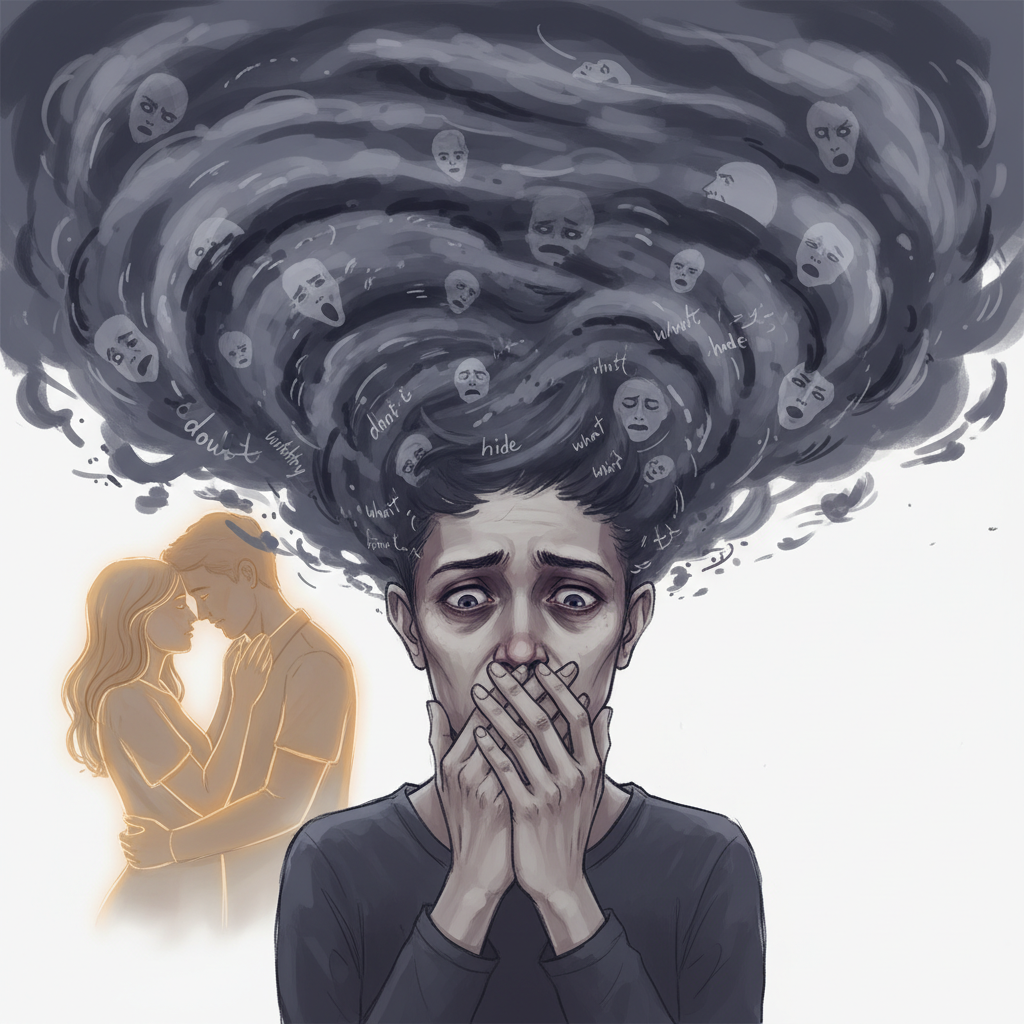
Confessing in ROCD- OCD Counselling Glasgow
Who is Confessing in Relationships OCD For?
This article is for individuals who:
Constantly worry about having done something wrong in their relationship, even when there's no evidence.
Experience intrusive thoughts about their partner or relationship that feel morally reprehensible.
Feel an overwhelming urge to confess these thoughts or perceived wrongdoings to their partner.
Find that confessing brings only temporary relief, followed by renewed anxiety.
Are in a romantic relationship and struggle with recurrent doubts and fears about their partner's love, commitment, or their own actions within the relationship.
Feel exhausted by the constant mental turmoil and the repetitive nature of their confessions.
Are seeking to understand the root of their relationship anxieties and find effective strategies for managing them.
Suspect that their relationship struggles might be linked to OCD but are unsure how to identify or address it.
Have been diagnosed with OCD or ROCD and are looking for specific information on the confessing subtype.
Partners of individuals struggling with ROCD who want to understand the condition and how best to support their loved one.
The Mechanics of Confession in ROCD
Confessing in ROCD isn't a sign of deep honesty; it's a symptom of a disorder. The act of confessing serves as a compulsion, a behaviour performed to reduce the anxiety caused by obsessions (intrusive, unwanted thoughts).
Obsessions: These are the intrusive, unwanted, and often distressing thoughts that plague individuals with ROCD. In the context of confessing, these might include:
"I looked at that person too long; I must be attracted to them and I'm betraying my partner."
"I had a fleeting thought about being with someone else; this means I don't truly love my partner."
"I didn't react perfectly to my partner's story; I must be uncaring or selfish."
"I remember a past minor indiscretion; this is proof I'm a bad person and will hurt my partner."
"My partner is too good for me; I'm going to mess this up somehow."
These thoughts are ego-dystonic, meaning they clash with the individual's values and self-concept. They are not reflections of genuine desires or intentions but rather the intrusive nature of OCD.
Compulsions: Confession is the primary compulsion in this subtype. It's the repetitive mental or behavioural act performed in response to an obsession. The goal is to neutralize the obsessive thought, prevent a feared outcome (e.g., partner leaving, relationship ending, being a "bad" person), or reduce the unbearable anxiety.
The confession itself can take many forms:
Verbal Confession: Directly telling the partner about the intrusive thought or perceived transgression.
Mental Review: Repeatedly replaying events or thoughts, trying to find definitive proof of "wrongdoing."
Seeking Reassurance: Asking the partner questions like, "Do you still love me?" or "Are you sure I didn't hurt you?" after a confession.
Digital Confession: Sending texts or emails detailing perceived wrongs.
The Temporary Relief: Immediately after a confession, there might be a fleeting sense of relief. The anxiety momentarily subsides. This is the reinforcement mechanism for the compulsion. The brain learns, "Confessing made the bad feeling go away, so I should do it again the next time I feel this way." However, this relief is ephemeral. The underlying OCD remains, and the intrusive thoughts will inevitably return, often stronger, perpetuating the cycle.
This pattern can be incredibly damaging. It can lead to the partner feeling constantly accused, confused, or exhausted by the repetitive confessions and the underlying anxiety. The relationship becomes a battleground for the individual's internal OCD struggles, rather than a space for genuine connection and intimacy. Understanding these mechanics is the first step toward breaking the cycle.
The Impact on Relationships
The constant need to confess can erode the foundation of trust and intimacy in a relationship. It creates an environment of perpetual doubt and anxiety, not just for the person with ROCD, but also for their partner.
Erosion of Trust: While the individual with ROCD confesses to build trust or alleviate guilt, the repetitive nature can paradoxically destroy it. The partner might start to doubt the individual's judgment, wonder if they are being manipulated, or feel constantly under scrutiny. They may begin to feel that the relationship is more about the individual's internal struggles than about their shared connection.
Emotional Exhaustion for the Partner: Constantly receiving confessions of perceived wrongdoings, especially when they are unfounded, is emotionally draining. The partner may feel like a therapist, a judge, or a rescuer, roles that can be unsustainable and damaging to their own well-being. They might feel confused about what is real and what is a product of OCD.
Increased Anxiety for the Individual with ROCD: While confession offers temporary relief, it reinforces the OCD cycle. This means the intrusive thoughts and the need to confess will likely return, leading to a persistent state of anxiety and distress. The individual may feel shame about their compulsions and the impact they have on their partner.
Avoidance and Withdrawal: Over time, the partner might start to withdraw emotionally or physically to protect themselves from the constant emotional turmoil. This withdrawal can then trigger more obsessions and confessions in the individual with ROCD, creating a downward spiral.
Focus on Flaws, Not Strengths: ROCD, particularly the confessing subtype, can cause the individual to hyper-focus on perceived flaws in themselves, their partner, or the relationship itself. This prevents them from appreciating the positive aspects and strengths of their bond. It’s like looking at a beautiful landscape through a dirty window; the view is obscured by the grime.
Difficulty with Genuine Intimacy: True intimacy requires vulnerability and trust. When one partner is trapped in a cycle of obsessive thoughts and compulsive confessions, genuine emotional closeness becomes incredibly difficult. The relationship becomes dominated by the OCD, rather than by the individuals within it.
It's crucial to recognize that these impacts are not intentional malice on the part of the individual with ROCD. They are the direct consequences of living with a debilitating mental health condition. Understanding this distinction is vital for both individuals in the relationship.
Distinguishing Confessing OCD from Genuine Relationship Concerns
It's easy to confuse the distress caused by ROCD with genuine relationship issues. However, there are key differences.
Nature of Thoughts
Confessing in Relationships OCD: Intrusive, unwanted, repetitive, often irrational, and ego-dystonic
Genuine Relationship Concerns: Based on observable behaviours, patterns, or communication issues
Basis of Confession
Confessing in Relationships OCD: Fleeting thoughts, minor perceived mistakes, or moral anxiety
Genuine Relationship Concerns: Actual hurtful actions, breaches of trust, or consistent patterns
Response to Confession
Confessing in Relationships OCD: Temporary relief followed by renewed anxiety — the cycle repeats
Genuine Relationship Concerns: Leads to resolution, learning, and growth, with more lasting relief
Partner's Reaction
Confessing in Relationships OCD: Confusion, exhaustion, feeling blamed, and repeated reassurance is needed
Genuine Relationship Concerns: Opens space for dialogue, problem-solving, and mutual understanding
Focus
Confessing in Relationships OCD: Internal fear, moral pressure, and catastrophic “what if” thinking
Genuine Relationship Concerns: Specific behaviours, communication breakdowns, or unmet needs
Pattern
Confessing in Relationships OCD: Highly repetitive, often escalating without a clear external cause
Genuine Relationship Concerns: More varied, responsive to real situations, and can be worked through
Distress Level
Confessing in Relationships OCD: Extreme and disproportionate to the situation
Genuine Relationship Concerns: Significant, but usually proportionate to what’s happened
For instance, if you confess to your partner because you genuinely forgot an important anniversary and feel deep remorse, that's a normal relationship concern. You would likely apologize sincerely, discuss how to prevent it from happening again, and work towards repair.
However, if you confess because you had a fleeting thought about someone else while walking down the street, or because you felt you didn't express enough enthusiasm for your partner's story, and this confession is driven by overwhelming anxiety and a need for absolute certainty that you are "good," then it leans towards ROCD. The distress is out of proportion to the "offense."
Strategies for Managing Confessing in Relationships OCD
Managing ROCD, especially the confessing subtype, requires a multi-faceted approach. It's not about eliminating doubts entirely but about learning to tolerate uncertainty and reduce compulsive behaviours.
1. Understanding and Acceptance
The first step is acknowledging that ROCD is a legitimate mental health condition. It's not a reflection of your character or your love for your partner. Acceptance doesn't mean liking it; it means recognizing its presence without judgment. This can be incredibly freeing, shifting the focus from "What's wrong with me?" to "How can I manage this condition?"
2. Cognitive Behavioral Therapy (CBT)
CBT is a cornerstone of OCD treatment. It helps individuals identify and challenge distorted thought patterns and develop healthier coping mechanisms.
Cognitive Restructuring: This involves learning to recognize the irrational nature of intrusive thoughts and developing more balanced perspectives. Instead of believing "This thought means I'm a terrible person," the goal is to think, "This is an intrusive thought caused by OCD, and it doesn't define me."
Identifying Cognitive Distortions: ROCD often involves distortions like all-or-nothing thinking (if I have one bad thought, I'm entirely bad), fortune-telling (I know I'll mess this up), and mind-reading (I know what my partner is thinking about my perceived flaw). Recognizing these helps dismantle their power.
3. Exposure and Response Prevention (ERP)
ERP is the gold standard for treating OCD. It involves confronting feared thoughts or situations (exposure) without engaging in the compulsive behaviour (response prevention).
Creating an Exposure Hierarchy: This involves listing feared situations or thoughts from least to most anxiety-provoking. For confessing ROCD, this might include:
Low level: Having a fleeting thought about an ex while watching a movie.
Mid level: Thinking about a minor social faux pas from last week.
High level: Experiencing an intrusive thought about infidelity.
The Response Prevention: The crucial part is not confessing, not seeking reassurance, and not mentally reviewing the "offense" after the exposure. The goal is to allow the anxiety to rise and then naturally fall without engaging in the compulsion. This teaches the brain that the feared outcome doesn't happen and that the anxiety is tolerable.
Partner Involvement (with caution): Sometimes, a therapist might guide the partner on how to respond (or, more importantly, not respond) to confessions. The partner should avoid providing reassurance, as this feeds the OCD cycle. They can, however, offer support by acknowledging the difficulty of the struggle without validating the obsessive thought itself.
4. Mindfulness and Acceptance Commitment Therapy (ACT)
Mindfulness practices help individuals become more aware of their thoughts and feelings without getting entangled in them. ACT focuses on accepting difficult thoughts and emotions while committing to values-driven actions.
Observing Thoughts: Learning to view thoughts as transient mental events, like clouds passing in the sky, rather than absolute truths.
Defusion Techniques: Practicing techniques to "unhook" from distressing thoughts, such as repeating the thought until it loses its meaning or visualizing it written on a leaf floating down a stream.
Values Clarification: Identifying what truly matters in life and in the relationship, and focusing energy on living in accordance with those values, even in the presence of anxiety.
5. Self-Compassion
Individuals with ROCD often struggle with intense self-criticism. Practicing self-compassion involves treating oneself with the same kindness and understanding one would offer a friend. This counteracts the harsh inner critic that fuels OCD.
6. Professional Help
Seeking help from a qualified mental health professional specializing in OCD and ROCD is paramount. Therapies like CBT and ERP, when delivered by an experienced practitioner, can be life-changing. If you are in the UK, consider looking for Anxiety Counselling Glasgow . Exploring options like Anxiety Therapy Glasgow City Centre, or Anxiety Therapy Glasgow West End can also be beneficial.
The Role of the Partner
A partner’s response can significantly influence the trajectory of ROCD. While it's challenging, their role is crucial in supporting recovery.
What Partners Can Do:
Educate Yourself: Understanding ROCD is the first step. Learn about obsessions, compulsions, and the specific nature of ROCD. Resources like the International OCD Foundation (IOCDF) offer valuable information.
Avoid Reassurance Giving: This is perhaps the hardest but most critical task. When your partner confesses, resist the urge to say, "Don't worry, you didn't do anything wrong," or "Of course I still love you." While well-intentioned, reassurance acts as a temporary fix that strengthens the OCD cycle. Instead, acknowledge their distress without validating the obsessive thought. A neutral response like, "I hear that you're feeling anxious," can be more helpful.
Encourage Professional Help: Gently but firmly encourage your partner to seek professional treatment from an OCD specialist. You can even offer to help them find a therapist or attend initial appointments for support.
Set Boundaries: It's essential to protect your own mental health. While supporting your partner, you don't have to tolerate constant accusations or emotional distress. Communicate your needs kindly but clearly.
Focus on the Relationship Outside of OCD: Make time for positive interactions, shared activities, and genuine connection that are not centered around the OCD. Remind yourselves of the love and joy that exists beyond the disorder.
Practice Patience and Compassion: Recovery from OCD is a journey, not a destination. There will be good days and bad days. Approaching the situation with patience and compassion can make a significant difference.
What Partners Should Avoid:
Dismissing Their Partner's Feelings: Even if the thoughts seem irrational, the distress is very real. Dismissing their feelings can lead to isolation and shame.
Getting Frustrated or Angry: While understandable, frequent frustration can escalate the situation and make the individual with ROCD feel worse.
Taking Confessions Personally: Remember that the confessions are driven by OCD, not necessarily by a genuine belief that the partner has done something wrong.
Becoming the "Reassurance Provider": This role is unsustainable and ultimately harmful to both individuals.
Blaming the Individual: OCD is not a choice. Blaming the individual for their condition will hinder progress.
For partners navigating this difficult terrain, understanding the dynamics of ROCD, much like understanding Navigating Relationships With Anxiety Understanding And Overcoming The Challenges, is key to fostering a supportive environment while maintaining personal well-being.
Mistakes to Avoid
Navigating ROCD and the urge to confess is fraught with potential pitfalls. Being aware of common mistakes can help individuals and their partners steer clear of behaviours that perpetuate the cycle.
Confessing as a Primary Relationship Tool: Mistaking compulsive confessions for genuine vulnerability or communication. This erodes trust and prevents authentic connection.
Seeking Constant Reassurance: Believing that enough reassurance will permanently quell anxiety. It's a temporary balm that ultimately strengthens the OCD.
Trying to "Think Away" the Thoughts: Engaging in mental suppression or arguing with intrusive thoughts. This often amplifies them.
Avoiding Relationships Altogether: Believing that relationships are too dangerous or difficult due to ROCD. This denies the possibility of fulfilling connections and prevents opportunities for growth.
Self-Medicating: Using alcohol or drugs to numb the anxiety associated with ROCD. This is a temporary escape that creates further problems.
Blaming the Partner: Shifting responsibility for managing ROCD onto the partner, expecting them to "fix" the intrusive thoughts or anxiety.
Expecting Immediate Results: Recovery from OCD takes time, effort, and persistence. Impatience can lead to discouragement and relapse.
Ignoring the Problem: Hoping that ROCD will simply disappear on its own. This rarely happens and often leads to the condition worsening over time.
Engaging in Ritualistic Behaviours: Beyond confession, other rituals like excessive checking, seeking external validation, or performing mental cleansing can also feed the OCD cycle.
Not Seeking Specialized Treatment: Trying to manage ROCD with general anxiety treatment or without professional guidance. OCD requires specific therapeutic approaches like ERP.
The Path Forward: Towards Healing and Wholeness
Confessing in relationships OCD can feel like being trapped in a relentless storm. The constant need to confess, driven by intrusive thoughts, can leave both individuals exhausted and disconnected. However, healing is possible.
The journey involves understanding that these thoughts are not truths but symptoms of a treatable condition. It requires courage to face the anxiety without resorting to compulsions, particularly the urge to confess. Embracing therapies like ERP and CBT, with the support of a qualified professional, provides the tools to dismantle the OCD cycle.
For those struggling, remember that you are not alone. The International OCD Foundation offers resources and support networks. Relationships can heal and thrive when individuals are equipped with the right strategies and compassion. It's about reclaiming intimacy from the grip of OCD, fostering genuine connection, and building a relationship grounded in acceptance, understanding, and shared growth. This can be a challenging path, akin to navigating a labyrinth, but with the right guidance, the centre – peace and authentic connection – is attainable.
Frequently Asked Questions (FAQs)
Can Confessing in Relationships OCD Actually Harm a Relationship?
Yes, confessing compulsively due to ROCD can significantly harm a relationship. While the intention might be to alleviate guilt or seek reassurance, the repetitive nature of these confessions, especially when based on unfounded fears, can erode trust, cause emotional exhaustion in the partner, and create a climate of anxiety rather than intimacy. The partner may feel constantly accused or confused, leading to withdrawal and relational damage.
How Do I Know If My Relationship Doubts Are ROCD or Genuine Concerns?
Genuine relationship concerns typically stem from observable behaviours, consistent patterns, or specific communication issues that can be discussed and resolved through dialogue. ROCD-driven doubts, however, are often intrusive, irrational, and disproportionate to the situation. They are characterized by intense anxiety, a repetitive need to confess or seek reassurance, and a feeling that no amount of validation is ever enough. If your doubts are persistent, distressing, and not based on concrete evidence, it's more likely to be ROCD.
What is the Most Effective Treatment for Confessing in Relationships OCD?
The most effective treatment for ROCD, including the confessing subtype, is typically Exposure and Response Prevention (ERP), a specialized form of Cognitive Behavioral Therapy (CBT). ERP involves gradually confronting feared thoughts or situations (exposures) while refraining from engaging in compulsive behaviours like confessing or seeking reassurance (response prevention). This helps individuals learn to tolerate anxiety and reduce the power of obsessions. Professional guidance from an OCD specialist is crucial for successful ERP.
How Can My Partner Support Me If I Have Confessing in Relationships OCD?
Your partner can best support you by educating themselves about ROCD, avoiding giving you reassurance (as this feeds the OCD cycle), and encouraging you to seek professional help. They can also practice patience and compassion, remind you of the positive aspects of your relationship outside of the OCD, and set healthy boundaries to protect their own well-being. It's important for them to understand that your compulsions are symptoms of a disorder, not a reflection of your love or character.
Is It Possible to Have a Healthy and Fulfilling Relationship While Struggling with Confessing in Relationships OCD?
Absolutely. While ROCD presents significant challenges, it is possible to have a healthy and fulfilling relationship. Achieving this involves dedicated treatment for the OCD, such as ERP, which helps manage intrusive thoughts and reduce compulsive behaviours. It also requires open communication (about the OCD, not about the obsessions themselves), mutual understanding, and a commitment from both partners to navigate the difficulties together. With the right support and strategies, individuals can learn to manage their ROCD and build strong, resilient relationships.
Can ROCD Ever Go Away Completely?
While OCD can be effectively managed to the point where it no longer significantly impairs daily life or relationships, the concept of it "going away completely" can be misleading. For many, OCD is a chronic condition that requires ongoing management strategies. Think of it like managing diabetes; you don't "cure" it, but you learn to live a healthy life with it through consistent management. With dedicated treatment and practice, individuals can significantly reduce the intensity and frequency of symptoms, leading to a high quality of life and healthy relationships.