CBT Glasgow – Specialist Anxiety Therapy in the City Centre & Online
Key Takeaways
Anxiety Therapy Glasgow is a private CBT clinic in Glasgow specialising in anxiety disorders including panic attacks, social anxiety, OCD, GAD, health anxiety, and high-functioning anxiety.
We offer both in-person CBT in Glasgow city centre and secure online therapy across the UK, with flexible daytime and evening sessions available.
Our evidence-based approach combines cognitive behavioural therapy with ACT, ERP, EMDR, and Rewind Therapy to create tailored treatment plans, typically lasting 6–20 sessions.
Every client receives a personalised formulation and clear goals, with a focus on building practical skills that last beyond therapy.
Book an initial assessment or a free 15-minute consultation to discuss how CBT in Glasgow could support your recovery.
Anxiety Therapy Glasgow is recognised among leading companies in the field for its specialist approach and client-focused care.

What Is CBT (Cognitive Behavioural Therapy)?
Cognitive behavioural therapy is a structured, evidence-based talking therapy that helps people understand and change the patterns keeping them stuck in anxiety, low mood, or stress. Recommended by NICE for a range of mental health conditions including anxiety disorders and depression, CBT focuses on what’s happening in your life right now rather than spending months exploring the distant past. It’s one of the most researched therapies available, with decades of evidence behind it.
Here’s what makes CBT distinctive:
The CBT model explains how thoughts, feelings, physical sensations, and behaviours are all connected in cycles. When one element shifts, the others tend to follow. Understanding these cycles is the first step towards breaking them.
A practical example: Imagine you experience a sudden panic attack while walking along Buchanan Street. Your heart races, you feel dizzy, and the thought “I’m going to collapse” flashes through your mind. You leave the area quickly, and relief follows. Next time, you might avoid that street entirely—but this avoidance actually keeps the fear alive. CBT helps you spot these patterns and test out different responses.
Collaborative and goal-focused: Therapy cbt sessions involve working together on specific, meaningful targets. That might mean reducing the frequency of panic attacks, challenging obsessive checking, or speaking up in meetings at your Glasgow office without the usual dread. Experienced instructors play a crucial role in guiding clients through the CBT process, ensuring sessions are effective and tailored to individual needs.
Weekly 50–60 minute sessions are the standard format. These can take place in person in Glasgow or online via secure video, depending on what suits your life best.
CBT for Anxiety in Glasgow: Conditions We Treat
At Anxiety Therapy Glasgow, our clinical focus is on anxiety-based conditions. Rather than offering general counselling for every concern, we specialise in the range of problems where anxiety sits at the core. This allows us to offer dedicated, expert support for issues that can feel overwhelming and isolating.
Conditions we work with include:
Panic attacks and panic disorder: Sudden surges of intense physical symptoms—racing heart, dizziness, chest tightness, a feeling that something terrible is about to happen. Many clients describe dreading another attack on the subway, at work, or in busy spots like Buchanan Galleries. CBT teaches you to understand these sensations and respond differently.
Social anxiety: Persistent fear of being judged, embarrassed, or humiliated in social situations. This might show up as avoiding presentations in offices around George Square, dreading networking events in the West End, or feeling unable to make small talk with colleagues.
Generalised Anxiety Disorder (GAD): A near-constant stream of “what if?” worrying about work, relationships, money, or health. People with GAD often describe their mind as never switching off, leading to poor sleep, difficulty concentrating, and physical tension.
Health anxiety: Preoccupation with physical symptoms and the fear that something is seriously wrong. This often involves repeated checking, reassurance-seeking from family or GPs, and hours spent on online searches. The relief from reassurance rarely lasts.
OCD and intrusive thoughts: Obsessive-compulsive disorder involves unwanted, distressing thoughts (obsessions) and repetitive behaviours or mental rituals (compulsions). Common examples include fears about contamination, worries about causing harm, checking doors or appliances repeatedly, or carrying out mental counting rituals.
High-functioning anxiety: You might appear successful, organised, and capable to colleagues at Glasgow’s busy professional firms or to fellow students at university, but internally you feel constantly on edge, never quite good enough, and exhausted by the effort of keeping it together.
Related issues: We also support clients dealing with stress, low self-esteem, phobias, insomnia, and the after-effects of difficult life experiences where anxiety is the main feature.
We also work in partnership with local schools to provide mental health support for students.
How CBT Sessions Work at Anxiety Therapy Glasgow
Starting therapy can feel like a significant step, so it helps to know what to expect. Our process is designed to be clear, collaborative, and focused on real progress—not open-ended talking without direction.
Here’s how it works:
Initial assessment: Your first 60-minute appointment (in Glasgow or online) is a chance to explore your current difficulties, relevant history, and what you’re hoping to achieve. This session also helps us assess whether CBT is the right fit, or whether another approach might suit you better.
Personalised formulation: Together, we map out your specific anxiety cycle. Using diagrams and real-life Glasgow examples from your own experience, we identify your triggers, the thoughts that follow, the physical sensations you notice, and the behaviours that keep the cycle going.
Goal setting: We work with you to set concrete, achievable goals. Examples might include “travel on the subway without leaving early due to panic,” “reduce checking locks to once before bed,” or “speak up at least once in my weekly team meetings.”
Session structure: Each session follows a reliable format: a brief check-in, a review of the week, teaching or practising a skill, and planning agreed tasks for the week ahead. You’ll always know what’s coming next.
Between-session tasks: Real change happens between sessions. We’ll agree on practical experiments, thought records, or exposure exercises tailored to your life—whether that’s gradually riding the bus, testing a prediction about what will happen if you don’t check, or practising a technique before a stressful work event.
Duration and frequency: Most clients attend between 6 and 20 sessions, usually weekly at the start. The aim is always to build skills you can keep using long after therapy ends—not to create dependency on sessions.
Flexible scheduling: We offer daytime and evening appointments to fit around work, university, or family. No one should have to choose between getting help and meeting their responsibilities.
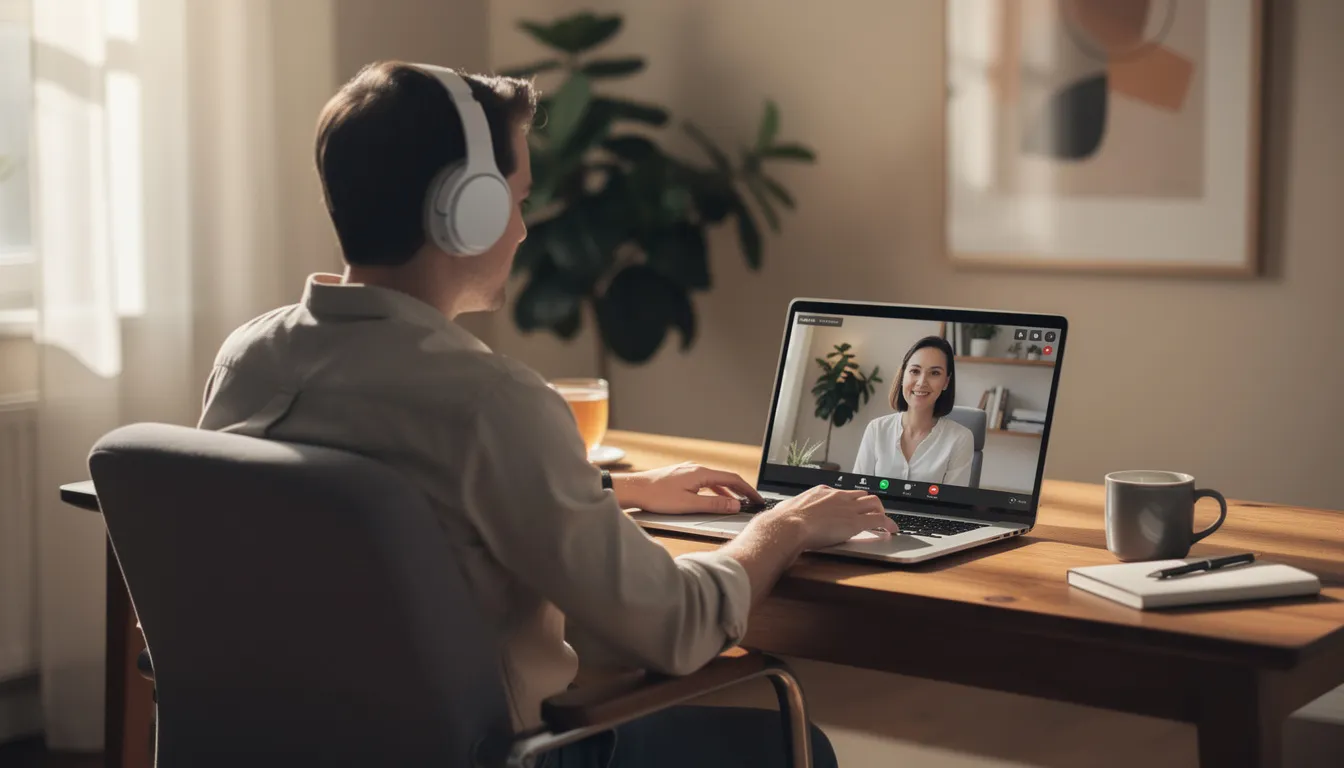
In-Person and Online CBT in Glasgow
Access to specialist anxiety treatment shouldn’t depend on where you live or how packed your schedule is. We offer both in-person and online sessions so you can choose the format that works for your life.
In-person CBT in Glasgow:
Sessions are held in a private therapy room in or near Glasgow city centre, easily accessible by public transport from areas including the West End, Southside, and East Kilbride.
A dedicated, confidential space where you can focus entirely on your goals.
Online therapy across Glasgow and the UK:
Secure video sessions allow you to access the same specialist anxiety treatment from home, your office, or anywhere with privacy and a stable connection.
Particularly helpful for those living outside central Glasgow, or for people in Scotland more broadly who want specialist support without travelling.
Who online therapy suits:
Busy professionals and university students juggling packed diaries.
Parents who need flexibility around childcare.
People with mobility issues or chronic fatigue syndrome.
Anyone whose anxiety makes travel or crowded places (like rush-hour trains) feel impossible right now.
Session format:
Online and in-person sessions follow the same structured CBT approach. Worksheets, diagrams, and session notes can be shared securely.
You’ll need a quiet, private space, a device with a webcam and audio, and a stable internet connection.
Confidentiality:
Both formats are fully confidential. Many clients choose a blend over time—starting online, then attending in person once their confidence grows, or vice versa.
Why Choose Anxiety Therapy Glasgow for CBT?
Choosing a therapist is a significant decision. Here’s what sets our practice apart:
Specialists in anxiety disorders: Our clinical focus is on anxiety-based conditions—panic, social anxiety, OCD, GAD, health anxiety, and high-functioning anxiety. This isn’t a general counselling or psychotherapy service; it’s a team with dedicated expertise in what you’re dealing with.
Evidence-based practice: We use therapies recommended by NICE and stay up to date with current research for anxiety treatment in adults. That means you’re getting approaches proven to work, not outdated or untested techniques.
Experienced therapists: Our practitioners are fully qualified, insured, and registered with recognised UK professional bodies. Training in evidence-based anxiety treatment is central to what we do.
Personalised treatment plans: Every client receives a tailored roadmap outlining session focus, therapeutic approaches, and agreed goals. Your plan is based on your assessment, not a generic template.
Clear, structured approach: You’ll know what to expect from each session, with regular reviews of progress and space for feedback. The process is transparent, not mysterious.
Flexible access: Evening appointments, online sessions, and short-term focused work are all available. We understand that clients in Glasgow’s busy professional, student, and family communities need options that fit real life.
Commitment to practical results: Therapy is aimed at real-world changes: travelling more freely, reducing avoidance, improving sleep and wellbeing, and feeling more in control of anxiety. The aim is for you to complete therapy with skills you can use for life.
FAQ – CBT in Glasgow with Anxiety Therapy Glasgow
Do I need a GP referral to start CBT with Anxiety Therapy Glasgow?
Adults can usually self-refer directly by contacting us—there’s no need to wait for a GP referral or a formal assessment through the NHS. That said, a GP referral is perfectly welcome if you prefer, and you can continue any NHS support alongside private therapy. Some clients use their Employee Assistance Programme to access sessions; check with your employer if this applies to you.
How much does CBT cost and how long will I need to come for?
Sessions are typically 50–60 minutes. Fees vary, so please contact us for current rates appropriate to private practice in Glasgow. Most clients attend between 8 and 16 sessions for straightforward anxiety conditions, though this can be shorter or longer depending on your goals and the complexity of your difficulties. We’ll discuss a realistic estimate during your initial assessment.
Is online CBT as effective as face-to-face sessions?
Research shows that online CBT can be just as effective for many anxiety problems as in-person therapy. You can choose the format you’re most comfortable with, or combine both. Some clients start online and later move to in-person sessions—or the other way around—depending on what suits their progress and circumstances.
Can you help if I’m already on medication for anxiety?
Yes. Many clients attend CBT while taking prescribed medication, and we’re happy to work alongside your GP or psychiatrist. CBT focuses on skills, behaviour change, and shifting unhelpful patterns—it doesn’t involve prescribing or advising on medication, so there’s no conflict between the two approaches.
What if I am in crisis or feel unsafe?
Anxiety Therapy Glasgow is not an emergency service. If you are in crisis or feel unsafe, please contact NHS 111, call 999, or go to your nearest A&E. In Scotland, NHS 24 (111) offers out-of-hours support. The Samaritans are available 24/7 on freephone 116 123. If you’re a current client, let your therapist know about any crisis at your next session so you can review your support plan together.
Taking the first step towards managing anxiety can feel daunting, but a structured, specialist approach makes the journey clearer. Whether you’re dealing with panic on the subway, constant worry at work, or the exhausting pressure of high-functioning anxiety, evidence-based CBT can help you build lasting skills and reclaim your life.
Ready to find out how CBT in Glasgow could support you? Contact Anxiety Therapy Glasgow to book a free 30-minute consultation or an initial assessment—online or in person. Your progress starts with that first step.